Water Quality Testing Resumes
Test Results Updated March 20, 2026
- South Drive, Newtown Grant (headwaters)
- Below Hidden Lake Dam, Washington Crossing Road (mainstem)
- Green Street, Town Common (mainstream)
- Barclay Street (mainstem, furthest downstream)
In-field measurements are being taken for chloride (Cl−), nitrate, nitrite, electrical conductivity, and temperature. Results from the sampling on October 9, 2024, July 24, 2025, October 4, 2025 and March 20, 2026 are summarized below:
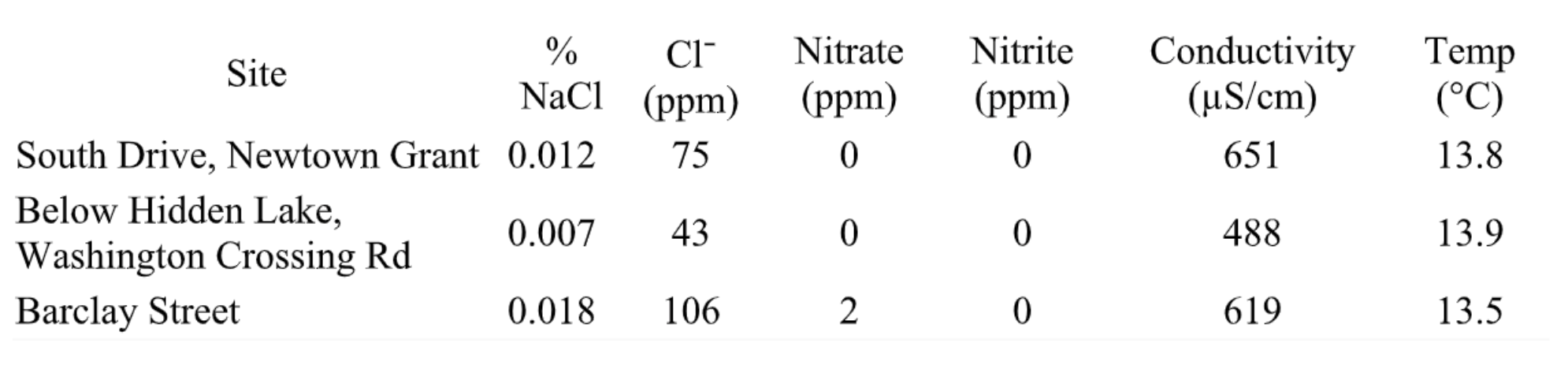
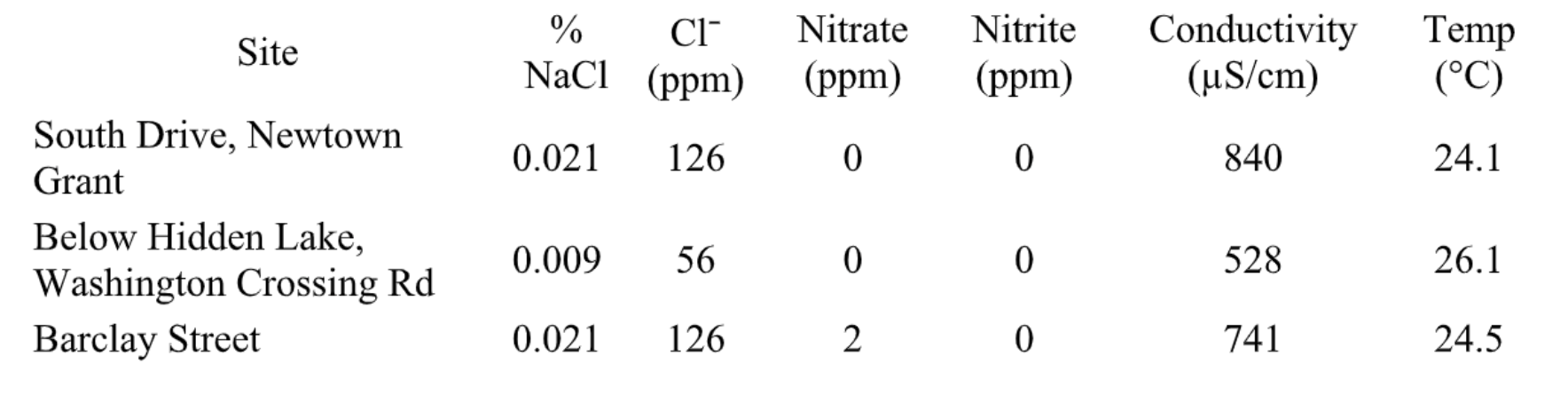

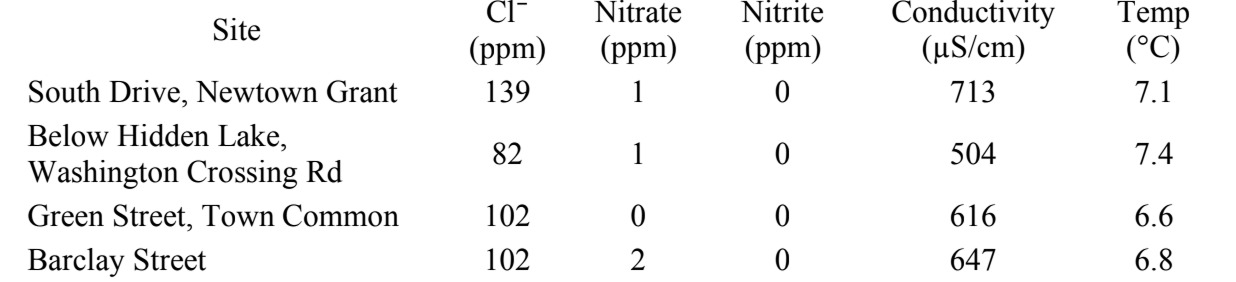
Nitrite has not detected at any site, while low nitrate levels (range 1-2 ppm) have been detected. Chloride was detected at all four locations. The observed chloride (1 2 3) and electrical conductivity (4) data indicate stressful/harmful conditions for biota, especially sensitive taxa.
The Coalition has now established a long-term monitoring program to track changes in water quality, detect pollution, and identify potential pollution sources. Special attention will be given to elevated water quality parameters that may pose risks to aquatic life, particularly sensitive species. Regular sampling is planned several times per year as part of this ongoing effort. Additional pilot studies could incorporate additional sites to test out the process for identifying sources of pollution.
2 S. Miess and A.R. Dzialowski, Salt Belt Index (SBI): A biotic index for streams within the North American “salt belt,” with proposed baseline chloride thresholds, 1 September 2024, Science of the Total Environment, 941, 173726
3 Maryland Department of the Environment, Maryland Biological Stressor Identification Process, BSID Process Report, June 2009, p. 19 – 20
4 W.H. Clements and C. Kotalik, Effects of major ions on natural benthic communities: an experimental assessment of the US Environmental Protection Agency aquatic life benchmark for conductivity, Freshwater Science. 2016. 35(1):126–138